A customer profile that moves with the market, and with trust in agents
A customer profile (jobs, pains, gains) goes stale as the market and trust in AI agents change. Here is how to keep it alive with evidence.

Omer Frank

A customer profile is really the answer to three questions about one customer segment: what are they trying to get done, what gets in their way, and what do they hope to gain. In short: jobs, pains and gains. It's called the Customer Profile Canvas, and the jobs are what people call Jobs to Be Done.
But there's something here that's easy to miss: those answers change, sometimes even pretty fast. In late 2024, an agent that does deep research on the web was a novelty. Only paying users had access to tools like that. A few months later, a similar capability was available for free in ChatGPT.
In other words, something that used to be "wow, I didn't know you could do that" quickly became "of course that exists." Which means a customer profile can't be a document you fill in at a workshop, photograph, drop in some Drive folder and forget. It has to live in a file that gets updated, with one owner.
In my setup the owner is a research agent, which hands what it finds to the strategy agent. And if your product is agentic, add one more line to the profile: how far customers already trust it to work on its own. That line changes too, just in a slightly different way.
What is a customer profile, and how is it different from a persona?
A customer profile describes what the customer is trying to do, not what they look like. A persona has an age, a role, a city, hobbies, all kinds of details that help us picture a person. But two 34-year-olds with the same role in the same city can be trying to get completely different things done.
And a job isn't only something the customer has to do. It also includes how they want to feel and how they want to be seen. A pain isn't only a problem in their way, it's also a risk they're not willing to take.
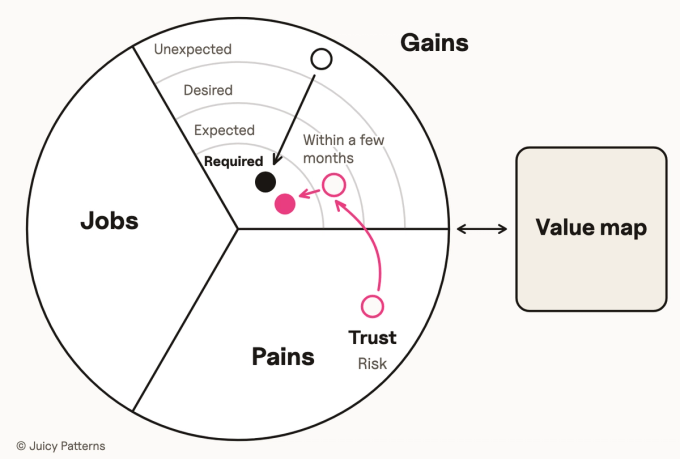
Opposite the customer profile sits the value map: what the product does to ease the pains and create the gains. But those gains don't stay put.
What was "wow" becomes obvious
A gain starts at the edge and moves inward. At first it's unexpected: nobody asked for it, and the customer sees it for the first time and says, "wow, I didn't know that was possible." Then it becomes desired: people know to ask for it, even if it doesn't exist in every product yet.
From there it becomes expected: competitors already have it, so the customer simply assumes it's there. And in the end it can become required: without it, there's nothing to talk about.
In short: unexpected → desired → expected → required. Nobody sits down and decides this will happen. Competitors copy, customers get used to it, and what was once an advantage becomes the standard.
Look at what happened to deep research on the web. In December 2024 Google launched a tool like this for paying users only. In February 2025 a similar tool arrived from OpenAI, on the $200-a-month plan. The same month, versions also came out in Perplexity, with a free tier, and in Grok. In April a scaled-down version reached free ChatGPT users too.
From $200 a month to a free version, at the same company, in under three months. So if at the start of 2025 you wrote in your customer profile that deep research was an unexpected gain, your profile no longer really described the customer. It described the customer from a few months earlier.
So every time a gain moves inward, you have to start looking at the edge for the next unexpected one.
And what happens to trust in AI agents?
Trust moves too, but for a different reason. Gains move because competitors copy. Trust moves because people use the agent, get to know it and learn where it's good and where it isn't.
At first, letting an agent work alone feels like a risk. In customer profile language, that's a pain. But as you use it, the risk can turn into a gain. And in certain tasks, that gain is already starting to become expected: people assume an agent will do some of the work without them having to hover over it.
And in the end it might even become required. A product you can't trust to work on its own just won't make it into the conversation. That's a prediction, of course, not something that has happened, and if it does happen, I assume it will happen first in tasks where the result is easy to check.
There's already some interesting data from the coding world. In February 2026 Anthropic published data on Claude Code usage. New users, with fewer than 50 sessions, let it run without asking for approval in about 20% of their sessions. By 750 sessions, it's already more than 40%.
But here's an interesting twist: experienced users also stop it more. They stop it about 9% of the times it starts working, compared to 5% for new users, around their tenth session. So the better they know it, the more freedom they give it, and the better they know when to stop it.
That's not blind trust. It's the trust of someone who has already seen the agent work.
Of course, you have to take these numbers with a grain of salt. It's research by the company that sells the agent, and the researchers themselves raise other explanations for the change. For example, part of it could come from the product's default setting, or from experienced users simply giving the agent more complex tasks.
And there's a figure that looks almost like the opposite. According to reports on Stack Overflow's 2025 developer survey, 84% of respondents use AI tools or plan to start, but 46% don't trust the accuracy of their output. A year earlier that was 31%.
It isn't really a contradiction. They use it, and they check.
And trust doesn't seem to move uniformly, either. It changes by task. If the result is easy to check, like code that has tests or research with sources, you can let the agent work alone fairly early. If a mistake can be irreversible, like deleting real data or an email going out to a customer, we'll probably keep approving every step for a long time.
I already trust my agents to build the right tools for my business, and to write and design content for me. But before anything goes live, I still want to see it. Even so, the friction has dropped almost completely, because I agree with most of their recommendations.
And that's exactly what I think needs to go into the customer profile. If your product has an agent, trust isn't a general gut feeling. It's a line in the profile.
For each job, write down what customers already let the agent do on its own, and what they still don't. Then check that line again in a few weeks, because it will move.
How do you keep a customer profile alive?
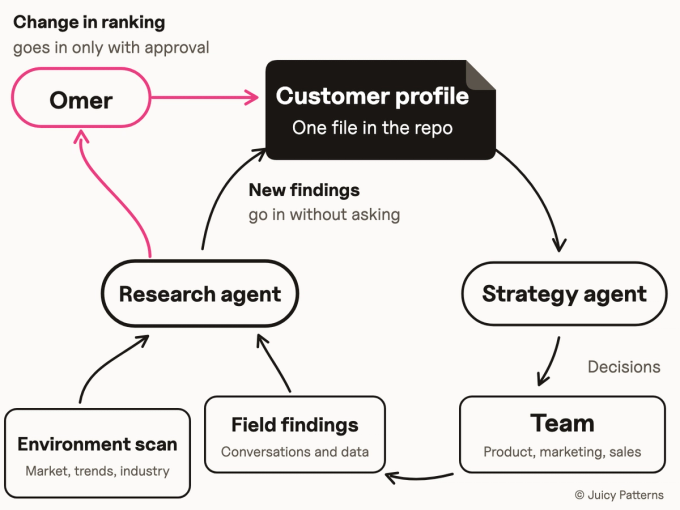
Give it one home and one owner, and decide in advance what the owner does on their own.
It starts with field findings: conversations with customers and data from the product. On top of that sits an environmental scan: what's happening in the market, the industry, trends, and the broader economy too. The scan can show that a certain gain is moving in the market, but only a conversation with a customer can show that it's moving for them too.
Next comes the research agent. It's the only one that writes to the file, and every new finding goes in with its source. The file itself is one customer profile, in one place, and every agent on the team reads it before producing anything for the customer, the same way it reads the design system.
The strategy agent reads the profile and the scan, and suggests what to do about the changes. And product, marketing and sales work from the same file. What they put out into the market should eventually come back as field findings and close the loop.
One writer, many readers.
I keep the file in the repo, the folder that holds the code and documents of the project. That way every agent working on the project can see it, without anyone having to remember to send it the latest version.
And what has already moved in my profile? So far, not a single line. No change has been confirmed with a customer yet, and I don't know which line will move first.
Who decides what changes?
Here I draw a fairly clear line. The research agent can add evidence on its own: a quote from a conversation, a source, one more case that reinforces something already written. But it doesn't change the ranking of the most important jobs, pains and gains by itself. It can suggest, bring evidence, and I decide.
Why? Because the moment you change the order of importance, it's strategy. Based on what's at the top of the list, the whole team starts building, writing and selling. And the market scan isn't enough on its own either. It can show that something changed out there, but before I put the change in the profile, I want to talk to a customer.
So for me there are three kinds of change: new evidence goes in on its own, a gain moving from one ring to another waits for a conversation with a customer, and a change in ranking waits for me. And the biggest decision already went through me in the first round. Because before you rank jobs, pains and gains, you have to decide who this profile belongs to in the first place.
For my own business, for example, the research agent came back with three possible segments and recommended product people who are becoming founders. Its reasons were that I already reach them in Hebrew, and that there's proof they pay for practical courses.
I chose a different segment: founding teams between idea and pre-seed who take part in entrepreneurship programs. They're the ones who most need discovery, tests and experiments, and that's exactly what I teach. In other words, I gave up a readier audience and the proof that it pays. The research agent also suggested a ranking for the jobs, pains and gains. That one I approved the same day.
In this case I'm my agent's customer. And my trust in it splits by task: a finding with a source is easy to check, so it goes in without asking. A choice that changes the direction of the business, I still keep for myself. If I were to write my trust line, it would look like this: Evidence, yes. Ranking, not yet.
And the checks I keep for myself feel temporary too. They're there so I can learn as I go.
Where do you start?
With one file and one owner.
Open one file and write in it the three most important jobs, three pains and three gains of one segment, in order. Next to each gain, mark which ring it sits in: unexpected, desired, expected or required.
If your product has an agent, add a trust line: for each job, what customers already let the agent do alone and what they still don't. Then pick one owner: one person on the team, or one agent in Claude Code. In both cases, define what they can add on their own and what waits for approval.
And finally, decide when the owner scans the environment and what they look for: what changed in the market, and which gain is starting to move a ring inward. But before you move it in the profile too, talk to a customer.
A customer profile isn't a poster from a workshop. It's a file that moves, because customers move.
Frequently asked questions
What is a customer profile?
A description of one customer segment in three parts: the jobs customers are trying to get done, the pains that get in their way, and the gains they hope for. Unlike a persona, it describes what they're trying to do, not what they look like.
How do you keep a customer profile up to date?
Keep it in one file inside the project, and give it one owner, a person or a research agent. The owner updates it from field findings and a scan of the environment, and everyone else only reads from it.
Can an AI agent maintain the customer profile on its own?
The evidence, yes: a new finding with a source goes into the file without asking. But the ranking of the most important jobs, pains and gains sets the direction of the business, so a change to it goes to a person for approval first. And what the scan finds in the market moves something in the profile only after a conversation with a customer confirms it.
Why does a gain that surprised customers quickly become expected, and then required?
Because competitors copy and customers get used to it. OpenAI's deep research tool, for example, went from a $200-a-month plan in early 2025 to a free version in under three months, and in those same months competitors also released similar tools, as reported. That's how a gain moves from unexpected to expected. The next step, to required, happens when a product without that gain no longer makes it into the conversation.
How does trust in AI agents change?
It builds up gradually, with experience. According to data Anthropic published in February 2026 about Claude Code, its coding agent, new users let it run without approval in about 20% of their sessions, and after 750 sessions already in more than 40%. In the customer profile this is a line that starts as a risk, on the pains side. In tasks where the result is easy to check, it already seems to be moving over to the gains, and maybe later it will reach required too.
Omer Frank
I started in visual design, moved on to product design and innovation, and for 17 years I have helped people and organizations work out what is worth building and how to design it well. Today I build with Claude Code and teach how to do discovery and design with it.