The Business Model Canvas in the AI era: move one square, and eight move with it
What happens to the Business Model Canvas when AI changes one square? One software company adds an AI support agent, and all nine squares move.

Omer Frank

A few days ago I was talking to the father of a girl in my daughter's kindergarten class. He's a senior developer at an established SaaS company, and like every conversation these days, this one got to layoffs fast. His company let go of 7% of its people. And the hardest part for him now, as a manager, is justifying new headcount. They simply need fewer people.
In his words, the models got so strong that it's no longer just juniors. A good chunk of the senior work is disappearing too. And what is he desperately short of? People who understand the business. He told me onboarding new hires was always a nightmare, and today he expects engineers and product people to plug into the business fast.
But there's a catch. How can you expect someone to understand the business if nobody ever taught them how? Usually people get a rough idea of who the customer is and what the product does. The rest they pick up as they go, in the mess, or from long documents nobody really reads.
There's a tool for this that I've been using for a decade: the Business Model Canvas. It breaks any business into nine squares, but its power isn't in the squares. It's in the story between them. In this post we'll take one software company, move one square, and watch the other eight move with it.
Wait, is AI really replacing senior people?
That's how it looks from his chair. The data, so far, tells a slightly different story.
A Stanford study, updated in August 2026 and based on payroll data for millions of US workers, found a 19% relative drop in employment among young workers aged 22 to 25 in AI-exposed occupations, compared with people their age in less exposed occupations. In plain English: companies are hiring fewer young people for work that AI already knows how to do. Among experienced workers there's no similar gap. And it's happening mostly through fewer hires, not layoffs.
So as of today, juniors get hit first. Seniors, at least in the data, not yet.
But on the important point he's right, and I'm flagging this as my own opinion: when code gets cheap, what stays scarce is knowing what to build, for whom, and how it will make money. That's as true for a senior as it is for a junior.
What is the Business Model Canvas, anyway?
One page, nine squares. Each square answers one question about how the business works.
Customer segments: who are we creating value for?
Value propositions: what do they get from us that they don't get anywhere else?
Channels: how do they hear about us, buy, and receive the product?
Customer relationships: how do we stay in touch, and who answers when something gets stuck?
Revenue streams: what do they pay for, and how?
Key resources: what must we have for this to work?
Key activities: what do we have to do well?
Key partners: who do we lean on?
Cost structure: how much does all of this cost?
One side of the canvas is the customer's story: there's a customer segment with a problem, and we have an offer that solves it. The offer reaches them through a certain channel, the relationship is kept in a certain way, and they pay for it in a certain way.
The other side is what happens behind the scenes: what we need to have, what we need to do, with whom, and at what cost. The gap between revenue and costs tells you whether the story holds up.
I use it in my own business too. I set up a strategy agent whose job is to go through the business square by square, once a month. On its first pass every square got a label: healthy, watch or at risk. And next to most of them, a check that could move the label. Some squares came back "at risk." Not fun, but now I know where to look.
And in my opinion it's also the fastest onboarding there is. Fill in the canvas in your first week at a new job, and you don't wait for someone to explain things. You show up to meetings with good questions.
Move one square, and eight move with it
Take a SaaS company that sells a support system to service teams and charges per rep. Its model worked for years: every rep is another subscription. Then it adds an AI agent to the product that answers some of the incoming tickets on its own.
Let's see what that does, square by square.
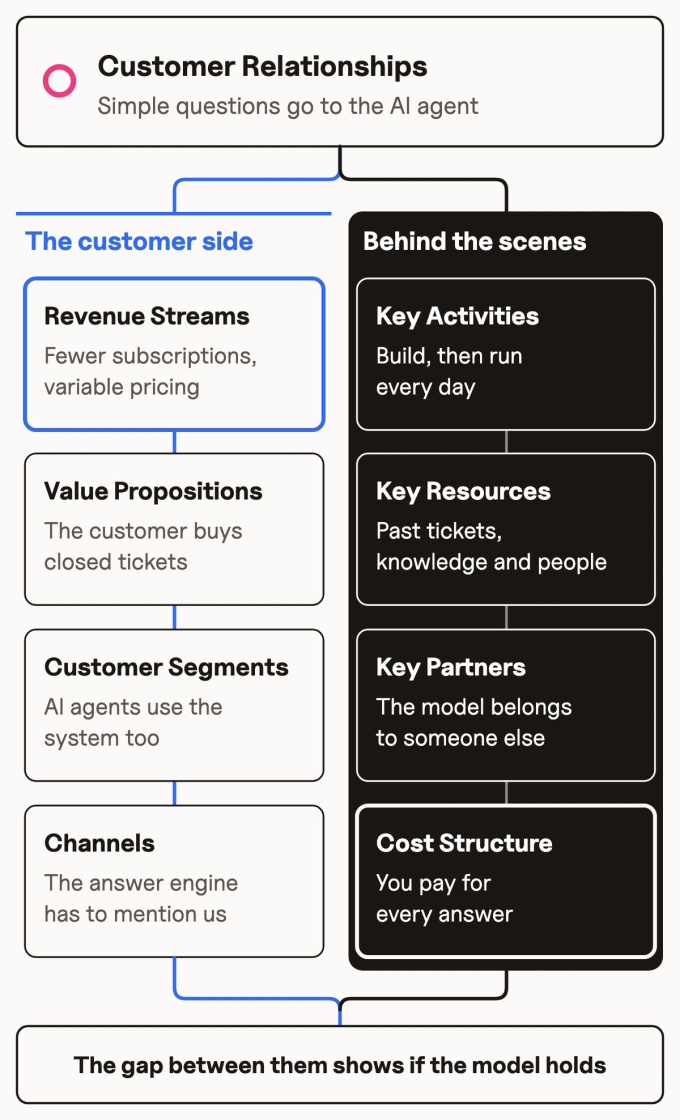
Customer relationships: this is where it starts
The AI agent answers the simple questions, and the reps handle what's left. Support is one of the first places companies bring in AI agents. It's also the place where people are already talking about walking it back.
In an October 2025 Gartner survey of 321 customer service leaders, only 20% had reduced headcount because of AI. And Gartner predicts that half of those who did will rehire for similar roles by 2027. That's a forecast, not a measurement.
But even without firing anyone, a service team that gets fewer tickets needs fewer new reps. And that moves the next square.
Revenue streams: fewer reps, fewer subscriptions
If the customer pays per rep, and needs fewer reps, revenue shrinks exactly when the product gets better. The company gives more and gets less.
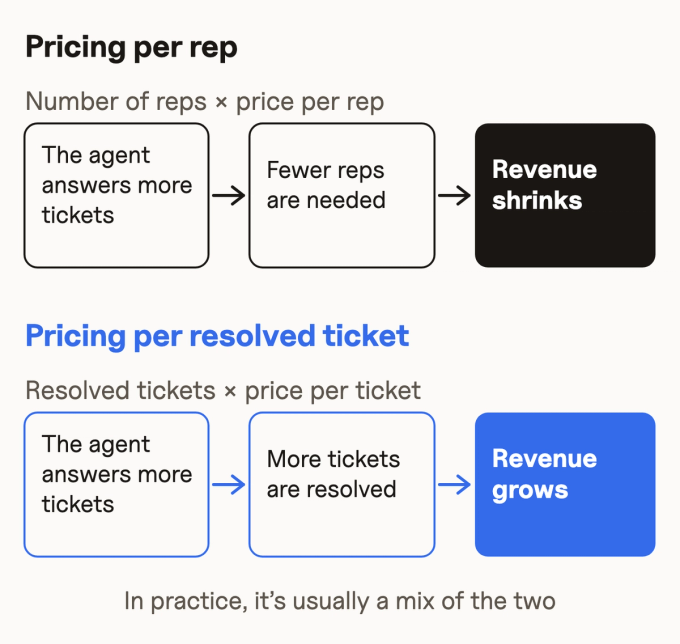
That's why companies in the space are starting to charge differently. As of October 2026, one of the leading support software companies charges less than a dollar per resolved ticket for its AI agent, with no per-user fee. And in June 2026 a large coding-tools platform switched its billing for AI use to consumption-based pricing.
And some companies are actually raising the price per user, thanks to AI features. So the picture is a mix, not the end of subscriptions.
This week: take one thing you sell, price it by outcome on paper, and compare that with today's price.
And if you're paying for a resolved ticket, you have to ask what you're actually buying.
Value propositions: from the screen to the outcome
Customers used to buy a system: a tidy screen where reps answer fast. Now they buy closed tickets. The question is no longer "how easy is it to work in the system," but "how many tickets got closed without anyone touching them, and how many were closed correctly."
An investor and founder from the SaaS world argues that in a world like this, software that only humans open is worth less. That's one person's opinion. But in our example the logic is easy to see: if the AI agent closes the ticket, nobody opens the screen.
And when what people buy changes, who uses it changes too.
Customer segments: who is the user, really
Until now the users were the reps. Now an AI agent does some of the work in the system. That same investor described how in his company's CRM, human users dropped from more than ten to two, plus one connection for AI agents. And the AI agents use the system far more than the people did.
That's one company's story, not a trend. But if it happens with our customers too, the most active user of the product is no longer a person.
This week: check whether an AI agent can use your product at all, through an API and not only through the screen.
Channels: how people find us
The way people search the web is changing too. In 2025 the Pew Research Center tracked 900 US adults and almost 69,000 searches they made. When the search engine showed an AI summary, people clicked a link in 8% of visits, compared to 15% without one.
So showing up in the results isn't enough. The answer engine has to mention us too.
This week: ask an answer engine about your product's category, and write down who gets mentioned. If it's not you, note who it is.
That's the customer's side. Now, behind the scenes.
Key activities: build, then run every day
The AI agent has to be built, and then run every day. On paper, building has become very cheap. According to early results the research institute METR published in April 2026, AI agents can already complete some coding tasks that take weeks. But a 2025 experiment by the same institute found that experienced developers worked 19% slower with AI tools.
So I won't say building is almost free. I will say that the faster building gets, the more weight the question "what should we build at all?" carries. That's reasoning, not a measurement.
This week: time one task with an AI agent and without one. Honestly, with a clock.
And an AI agent that answers customers every day has to know the answers. From where?
Key resources: what we must have
For the AI agent to answer correctly, the company needs a few things of its own: years of tickets and replies, organized product knowledge, and people who can tell when the AI agent is wrong.
Many say this data is the advantage nobody can copy. Maybe. But I haven't found any serious measurement for it, only opinions.
And there's one resource that isn't the company's at all.
Key partners: who holds the engine
The AI agent runs on someone else's model. The model provider is a partner, and at the same time a potential competitor: nothing stops them from building their own AI support agent. And every price change on their side lands straight on the last square.
Cost structure: every answer costs money
In classic software, every extra customer cost almost nothing. Here every answer the AI agent gives costs money, because it takes processing, every single time.
I know this one firsthand. In a product I'm building, every AI action costs real money. And when every action costs money, a flat price per user turns into a bet: a very active customer can cost more than they pay. The cost structure starts dictating the revenue streams.
This week: find out what one customer action costs.
Behind the scenes, AI makes building cheaper and adds a cost to every use. If you only see one side, you're not seeing the business.
And that closes the story. The AI agent changed the relationship with the customer, and from there the change traveled on: to revenue, to what people buy, to who uses it, to how they find us, to what we build and run, to what we must have, to who we lean on and to what all of it costs. One square moved, and eight moved with it.
Whoever can tell this story in two minutes understands the business. And that's exactly the skill the manager I met at my daughter's kindergarten is looking for.
Where do you start tomorrow morning?
With the company you work at today. Or with your own business, if you have one.
Print a page with nine squares, and take half an hour. Fill in each square with what you know. In a different color, mark what you're only guessing.
Then tell the story out loud, in two minutes, to someone on the team: who the customer is, what they get, how it reaches them, what they pay for, and what it costs us.
The places where the story gets stuck are exactly the questions. Take them to whoever knows: sales, support, finance. That's how you onboard yourself, without waiting for a document nobody reads.
And at the end pick one square, the one where the story got stuck the most, and test only that one this week. One square a week is enough.
Code got cheap.
Understanding the business hasn't.
And nine squares are a good place to start.
Frequently asked questions
What is the Business Model Canvas?
A tool that breaks any business into nine squares on one page: customer segments, value propositions, channels, customer relationships, revenue streams, key resources, key activities, key partners and cost structure. People use it to find new business models, and also to understand an existing business.
Is AI replacing senior developers?
As of August 2026, the employment data doesn't show it. According to a Stanford study, there's a 19% relative drop in employment among 22 to 25 year olds in AI-exposed occupations, compared with people their age in less exposed ones, mostly because of fewer hires. Among experienced workers there's no similar gap.
Layoffs are also more complicated than they look. According to Challenger's August 2026 layoffs report, AI was cited as a reason in about a quarter of the layoffs announced in the US since the start of the year. But the same report notes that mentioning AI in a layoff announcement can appeal to investors. There's even a name for it: AI-washing.
Meanwhile the bar keeps rising: according to PwC's June 2026 report, junior roles in AI-exposed occupations ask for far more skills, the kind that used to be required only of seniors.
How does AI change the business model of software companies?
The most visible change is in pricing: more companies are moving from per-user pricing to billing by usage or by outcome, and most often to a mix of several methods. At the same time, every customer action now has a processing cost, so revenue and costs have to be checked together. And in some cases, the most active user of the product is already an AI agent, not a person.
Does the canvas work for a small business that isn't a software company?
Yes. A bakery or an accounting firm fills in the same nine squares, but the answers are different. And there too, AI is already changing some of them, for example how customers find the business and how you answer them.
Sources
Stanford Digital Economy Lab, Canaries in the Coal Mine, updated August 12, 2026: https://digitaleconomy.stanford.edu/publication/canaries-in-the-coal-mine-six-facts-about-the-recent-employment-effects-of-artificial-intelligence
Gartner, customer service leaders survey and rehiring forecast, February 2026: https://www.gartner.com/en/newsroom/press-releases/2026-02-03-gartner-predicts-half-of-companies-that-cut-customer-service-staff-due-to-ai-will-rehire-by-2027
Pew Research Center, July 2025: https://www.pewresearch.org/short-reads/2025/07/22/google-users-are-less-likely-to-click-on-links-when-an-ai-summary-appears-in-the-results/
METR, research page (MirrorCode, April 2026): https://metr.org/research
METR, experiment with experienced developers, July 2025: https://metr.org/blog/2025-07-10-early-2025-ai-experienced-os-dev-study
Challenger, Gray and Christmas, layoffs report, August 2026: https://www.challengergray.com/blog/challenger-report-layoffs-fall-hiring-picks-up-ai-leads-for-fifth-straight-month
PwC, AI Jobs Barometer, June 2026: https://www.pwc.com/gx/en/services/ai/ai-jobs-barometer.html
Omer Frank
I started in visual design, moved on to product design and innovation, and for 17 years I have helped people and organizations work out what is worth building and how to design it well. Today I build with Claude Code and teach how to do discovery and design with it.